
Home » Little Hearts: Assessment, Self-Assessment, and Emotional Intelligence
The likes. The views. The shares. The insights. Hearts, you just wanted hearts. The photos of kids doing things. Their grades. Hearts, hearts.
Reflections on and critiques of the performance society are nothing new. Since the mid-1960s, philosophers and sociologists have been addressing the tendency to objectify reality and the needs that result from a dependence on a certain type of evaluation of reality (to name just a couple: G. Debord, The Society of the Spectacle and H. Marcuse, One-Dimensional Man). From the philosophical level to real life, today, in 2025, we have arrived at the so-called performance society, in which the evaluation of our products (social, aesthetic, lifestyle, but also scholastic and developmental) has become a new addiction, a behavioral dependency. In this distortion, everything becomes a form of expression, communication, narration, performance, and, above all, evaluation. And what happens then if we stop being evaluated? We stop existing.
Today, developmental specialists are questioning and finding numerous connections between these elements of evaluation dependence and anxiety disorders and school anxiety in adolescents and young adults, which have been rapidly increasing in recent years. Far be it from us to trivialize a complex disorder like anxiety, which typically has more than one cause, but encompasses multiple, we, as educational agencies, find ourselves questioning our role in this complex landscape.
School is par excellence the place of performance and evaluation, which in itself should not be dismissed, but should be supported by solid personal analysis, so that children can break free from the sole objective image conveyed through evaluation and gain the tools to construct a more critical and subjective self-image, one that reflects them as individuals, not as results.
But let's start with the definitions:
evaluation
/va·lu·ta·zió·ne/
feminine noun
Acquisition of elements that allow one to verify the effectiveness of an educational intervention and the student's progress.
Self-assessment
/au·to·va·lu·ta·zió·ne/
feminine noun
Evaluation of one's own performance and results achieved in relation to a pre-established objective.
A reflective process for both learners and teachers. For the former, it involves listing and defining what has been learned, thus identifying any further needs. For the latter, it involves identifying tools for critically examining the effectiveness of one's teaching.
I'll spend a few words on the concept of evaluation. It's clear to everyone that we're talking about a process that involves an objective measurement by a third party, a result based on certain premises.
When speaking of self-evaluation, one of the first words that comes to mind is relationship.
It may seem counterintuitive to talk about relationship in relation to a self-referential concept, but in reality, the process of self-evaluation involves multiple relationships: with oneself, with a system of reference parameters, with the expectations of one's family, teachers, and peers. It's a process that shifts the focus away from objective performance and puts the child at the center, along with the experience that led to the results achieved. By learning to self-evaluate individually, children learn to analyze the effectiveness of their actions and their personal and classroom efforts, based on the outcome and their state of mind. This is a basic logical process, but it becomes a fundamental skill for navigating the world of adult life. Furthermore, self-assessment provides children with the opportunity to reflect on their emotional state during preparation for the test and on their emotions at the time. This work is essential for developing emotional intelligence and the ability to regulate one's feelings even in times of stress, or even to be aware of and implement compensatory tools to address any weaknesses.
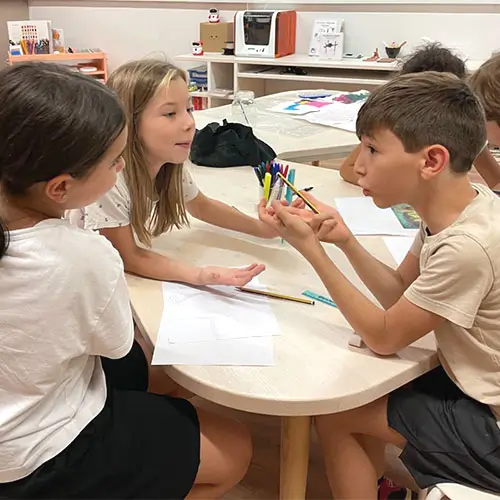
Group self-correction and self-assessment in the classroom becomes a valuable learning tool: children engage in discussion and support one another by revisiting unclear concepts or reinforcing acquired knowledge. They have the opportunity to reflect on their answers and their reasons, in an exercise of critical thinking and discussion that is invaluable and promotes cognitive growth. I won't dwell on how invaluable this is for teachers, too, who, by listening to children's self-assessments, can gain important feedback on their work and the learning climate in the classroom.
In fact, self-assessment becomes a powerful defusing factor for performance anxiety. With limited mental stress, the child will be free to reflect clearly on their work and their career path. By forming their own personal opinion, the child is also able to embrace objective assessment as a tool for growth and comparison, not as a source of social pressure.
The primary objectives of self-assessment are: empowering the child, building autonomy in their work, perceiving assessment not as a judgment but as a tool, and understanding the stakeholders and the objectives of the assessment process.
Our goal, and the reason why the assessment process at our school also includes a structured and comprehensive self-assessment session, is for children to grow with awareness of their own journey, free from anxiety and fear, in healthy, constructive competition among peers working toward the same goal and able to be guided by an adult in developing their potential. To achieve this, emotional balance is essential.
Self-assessment is just one of the tools we use daily at EducatioNest to help our children navigate their educational journey with peace of mind. From their earliest years in nursery school, children experience an environment where respect, nonjudgment, positive guidance, and kindness are central values. The rules of our school community are designed and decided by children and adults together, and teaching them to face the logical consequences of their actions is always preferred to exemplary punishment or reprimand. We are not a school that awards stars (or hearts!) based on merit or discredit, because we believe that every individual has value and should exist to be recognized for their unique qualities, not for their achievements.
In this environment, every talent, but also any weakness that may arise, any physiological conflict between friends, any deviation from their trajectory, is welcomed and embraced together, supporting children on this magnificent and sometimes complex journey of growth.
“Whatever kindness I give or receive, I always feel responsible for my emotions.”
VV, 5th grade

EducatioNest
The American Bilingual School
Via Sgarzeria, 1 – 41121 Modena
iscrive@educationest.org
P.IVA 03806400366
MAIN PAGES
SCHOOL
TOUCHPOINT
Data Protection Officer: rpd@formulaprivacy.it
Copyright 2026 EducatioNest | All rights reserved | VAT number: 03806400366
Made with ❤ by WonderMee