
Home » School Beyond Screens, in the Time of Covid-19
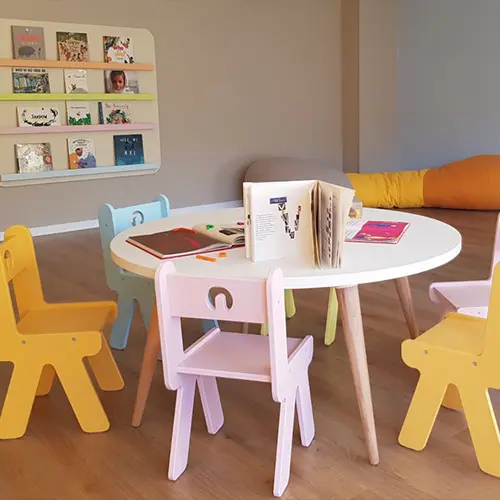
At the start of a vibrant second semester, in the middle of the school year, on a Sunday afternoon, the announcement arrives that the school must remain closed.
A health emergency.
We react to the first week of suspension by believing it to be just a brief interlude. We work to create new educational environments, workshops, and displays, to welcome our children into the joy of a new, carefully curated space, as if to say, "We've been waiting for you."
We approach the second week with the near-certainty that it will be our last. We invest time in the important work of documenting the children's learning and are working to record readings and songs to share with families on a new online platform, as if to say, "We're here for you, we'll be back soon."
Then comes the realization that the suspension will be extended.
How can we ensure everything continues, that the learning processes don't stop? Online learning is a complex reality for a school like ours. First, because of the very young age of our students, ages 0 to 8; second, and perhaps more importantly, because of our approach to teaching, the choice we've made to replace classroom teaching with a learning approach based on research and discussion, on the collective construction of meaning.
It's difficult to apply this idea to an online model where a teacher speaks to a group of listeners.
We spend a weekend brainstorming and discussing our ideas, and naturally, almost naturally, a hypothesis emerges for our new and temporary approach to teaching.
The children are sent a provocative set of questions, sources to consult, and topics to reflect on. The children are expected to provide an initial feedback on their research, which is then collected and organized by the teachers into a single document that restores the collective dimension to individual reflections. This document will then be presented and discussed as a large group in an online lesson. This lesson has little to do with a traditional online lesson, but rather feels more like a digital agora, where everyone finds a way to present and discuss their ideas, where doubts are raised, where hypotheses are strengthened, and that lively discussion leads to a revitalization, or rather, new stimuli that guide and amplify research.
“Every child should go to school because for me learning means being free” (Emma, 6 yo)
“Every child should have the opportunity to go to school to feel free to think and decide for their own future” (Annagiulia, 6 yo)
“I think that every child should have the opportunity to… become the person they want to be.” (Giacomo V., 7yo)
Study becomes a tool for self-realization and change, and a tool for help and support in resolving dramatic situations. And once again, current events are incorporated into the reflections. A new resurgence is the in-depth exploration of the experience of Tu Youyou, a scientist who won the Nobel Prize for discovering a cure for malaria using traditional Chinese medicine.
“I chose Tu Youyou because I liked that Tu Youyou cured everyone because I don't like malaria… let's hope she makes a medicine for the corona virus because some people are dying because of the corona virus so I would like Tu Youyou to make another medicine” (Elmo, 5yo)
“Elmo, my grandmother read to me in the newspaper that maybe in America scientists and doctors have found a vaccine for the corona virus, they are testing it… in my opinion Tu Youyou is a little too old and will no longer be able to cure the corona virus.” (Gabriele, 5yo)
And so distance learning manages to remain a tool for discussion and research, where the voices and perspectives of children join those of teachers, tracing new paths, writing new meanings, and supporting one another in the search for meaning.
The enthusiasm surrounding the success of the first online meetings with the first and second graders has led us to deepen the dialogue with the other children at school. We're starting moments of discussion and exploration with the preschool children, who are also engaged in complex explorations of meaning on topics closely intertwined with those addressed by their older classmates, and with the nursery school children, who are capable of restoring our perspective on things.
For those of us who refuse to accept the fact that school has closed doors, online learning has opened new avenues that allow us to meet, reflect, hypothesize, laugh, and feel united and, together, creators of knowledge.

EducatioNest
The American Bilingual School
Via Sgarzeria, 1 – 41121 Modena
iscrive@educationest.org
P.IVA 03806400366
MAIN PAGES
SCHOOL
TOUCHPOINT
Data Protection Officer: rpd@formulaprivacy.it
Copyright 2026 EducatioNest | All rights reserved | VAT number: 03806400366
Made with ❤ by WonderMee